Shoe elastic bands
Woven structures that provide controlled stretch and foot conformity in upper and side panel applications.
Elastic bands, strips, cords, laces, and narrow weaving solutions used in shoe and slipper production.
Narrow weaving parts in shoe and slipper production are not just accessories; The product's fit to the foot, fastening method, flexibility, edge finish, and visual identity are directly affected. Meram Narrow Weaving evaluates shoe elastic and elastic bands,, shoelaces and cordsribbon and binding solutions according to the usage scenario.
Elastic-rigid bands, straps, cords, and laces, which are part of our past production experience, can be varied according to different yarn and weaving structures. Color, weight, density, yarn type, and size should be planned together according to the product design.
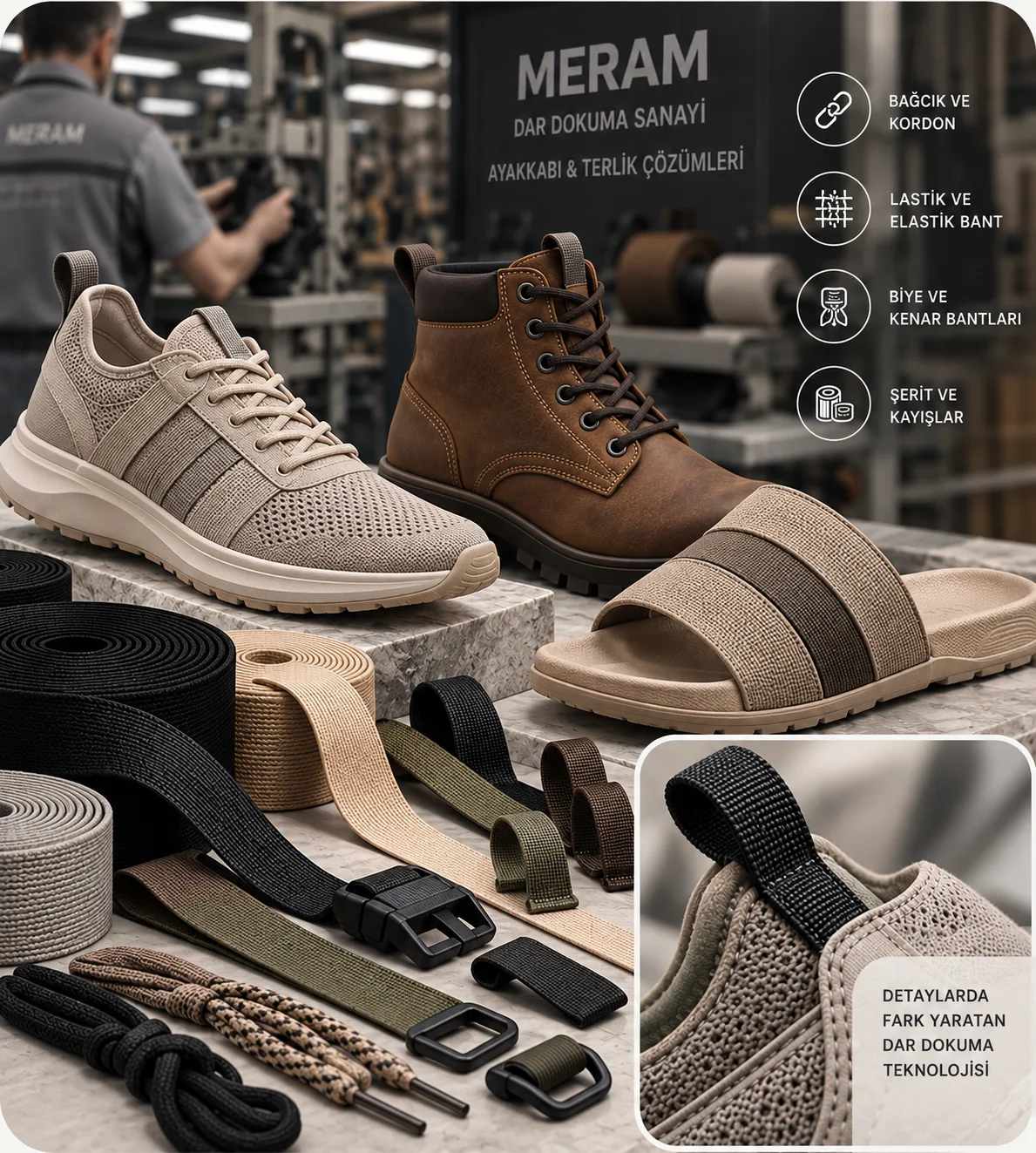
Different product groups can be evaluated specifically for the project according to the function, size, and design features required by the area of use.
Woven structures that provide controlled stretch and foot conformity in upper and side panel applications.
Flat, round, and various weave options depending on the model's appearance and fastening style.
Strips suitable for surface, flexibility, and stitching expectations in slipper and sandal designs.
Fine, narrow weave solutions providing a clean finish in the upper, lining, and joint areas.
Sturdy woven eyelets at the back of the shoe for grip and ease of wearing.
Functional bands developed according to buckle, accessory, color, and size requirements.
In shoe and slipper applications, the selection of narrow woven products is evaluated together with size, weaving structure, flexibility, color, and usage method.
The appropriate width and weave structure are determined according to the product's connection, carrying, edge finishing or elasticity needs.
Different color, pattern and surface options can be evaluated according to the visual language of the product and the application area.
Strip, webbing, elastic, bias or cord alternatives are selected according to the purpose of use.
The narrow weave solution is shaped according to functions such as hanging, fixing, gathering, carrying or edge closing.
Narrow woven products are evaluated to ensure compatibility with the final product's production process and assembly method.
Suitable product structure, color, and size alternatives can be evaluated together in line with project information.
Stretch rate and recoveryThe elastic band is evaluated according to its point of use to maintain its form on the upper or slipper. Yarn composition and weaving density directly affect the product feel.
Width, thickness, and stitching compatibilityare planned together in terms of the balanced integration of the band with the shoe parts. Laces, binding, and heel strips are not produced with the same technical structure.
Color, texture and sample studyis important for establishing visual integrity with the sole, upper and accessories. Surface character and tonal approach can be compared through the reference material.
Sample images from Meram Narrow Weaving's product groups for the shoe & slipper sector; compiled to closely examine different narrow weaving structures and usage diversity.
Although narrow woven components may seem small in shoe and slipper production, they directly affect the feel of the product, ease of putting on and taking off, form, and visual integrity. Shoe elasticProducts such as laces, ribbons, webbing, and binding can perform different functions on the same model; therefore, it is important to use the right product family at the right point.
In upper or connection areas where flexibility is required, narrow woven elastic, in tying and adjustment needs, shoelaces and cords, in decorative or auxiliary flat bands, woven tape, and in firmer connections, woven webbing comes to the forefront. In models requiring edge finishing, bias binding is also considered.
In narrow woven shoe products, not only color matching but also the stitching method, the material it comes into contact with, the folding points, the daily use of the product, and its applicability in the production line are important. When products such as slipper webbing or shoe elastic bands are the visible part of the design, surface character and color continuity also contribute to brand perception.
In the new model development process, the reference sample, target size, color, and the point of use of the product on the shoe should be shared together. In this way, not only a narrow woven product that looks similar but also a product structure suitable for the actual function of the model can be evaluated.
Basic questions that facilitate decision-making about product selection, production structure and areas of use.
Different narrow woven product products can be used, such as shoe rubber, elastic band, laces, cords, ribbons, woven tape, and binding.
It is a type of woven elastic band used on shoes to provide flexibility and conform to the foot.
Special lace solutions can be developed by evaluating the color, yarn, form, and surface characteristics according to the design of the model.
Yes. Suitable ribbon or tape structures can be evaluated according to the carrying and design needs of the slipper model.
It can be used to trim edges, cover the seam line, or create a decorative finish.
Width, color, yarn, weave density, elasticity, surface appearance, and stitching fit are evaluated together.
Work can be done by evaluating the target structure and dimensions from an existing shoe sample or narrow woven piece.
Depending on the product's function—stretching, binding, edge closing, carrying, or decorative—elastic, lace, ribbon, webbing, or binding alternatives are determined.
Footwear & Slippers Main product and search terms related to narrow woven products for the sector.
Share your product group, size, color, pattern and area of use information; let's evaluate the options suitable for your needs together.